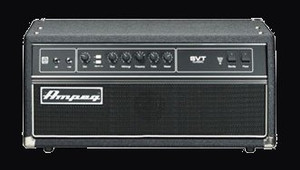
Product images are provided for reference and may not represent the exact model, configuration, or included components.

At A Glance

Preamp Tube
Premium 2 x 12AX7
Driver Tube
Premium 1 x 12AX7, 2 x 12AU7
Power Amp Tube
Premium 6 x 6550
Output Power Rating
300 Watts RMS minimum continuous @
Signal to Noise Ratio
80 dB (20 Hz-20 kHz, unweighted)
Maximum Gain
67 dB @ 1 kHz, tones centered | -3 dB @ 40 Hz and 15 kHz
Bass
+12/-12dB@40 Hz
Midrange
+10/-20 dB @ 220 Hz, 450 Hz, 800 Hz, 1.6 kHz, or 3 kHz
Treble
+15/-20 dB @ 4 kHz
Ultra Lo
+2 dB @ 40 Hz, -10 dB @ 500 Hz
Ultra Hi
+9 dB @ 8 kHz
Power Requirements
10A(Slo Bio), 120VAC, 50-60HZ, 460W (HSVTCL)
Size (H x W x D
11.5 in/292 mm (with feet) x 24.0 in/610 mm x 13.0 in/330 mm
Weight
80 lb/36.3 kg (approximately)
Design
All-tube
Assembly
Designed and assembled in the U.S.A.
Tube Brand
JJ
Description

Ampeg produced the Heritage SVT-CL (HSVT-CL-U) as an all-tube bass amplifier head positioned as a premium, U.S.-designed-and-assembled entry in its Heritage line. The unit was built around premium components and was intended to deliver the classic SVT character that defined the SVT lineage.

The HSVT-CL-U ran a full tube complement: two 12AX7s in the preamp, one 12AX7 and two 12AU7s in the driver stage, and six 6550 power tubes delivering a minimum of 300 watts RMS continuous into 2 or 4 ohms at under 3% THD. The EQ section offered ±12 dB of bass adjustment at 40 Hz, asymmetric midrange control (up to +10/−20 dB) across five selectable centre frequencies (220 Hz, 450 Hz, 800 Hz, 1.6 kHz, or 3 kHz), and treble adjustment (+15/−20 dB) at 4 kHz. Two switched voicing filters — Ultra Lo and Ultra Hi — provided additional tonal shaping. Signal-to-noise ratio was rated at 80 dB (20 Hz–20 kHz, unweighted), with maximum gain of 67 dB at 1 kHz with tones centred. The unit measured 11.5 in × 24.0 in × 13.0 in (with feet) and weighed approximately 80 lb/36.3 kg. Power draw was rated at 460 W from a 120 VAC, 50–60 Hz supply requiring a 10 A slow-blow fuse.

Owners sourcing replacement tubes, fuses, or internal components should consult a qualified amplifier technician familiar with high-voltage tube circuitry before attempting any service work.

Q&A
Have Questions?
The owner archive

From the people who own them

Nothing in The Vault is for sale. These records exist so the instruments stay documented after the manufacturer moves on — and the most useful part of that record is what owners add to it.

Owner photos

Owner photos

Put yours on the record.

The catalog shot showed one finish, under one light, a long time ago. Yours has been played. Photos from owners are what the next person finds when they are trying to identify a part, match a finish, or work out whether the one they just bought is really what the seller said it was.

Comments

What do you know about this one?

Specs only go so far. What actually fits, what breaks first, what the factory got right and what everyone ends up changing — that lives with the people who own them, not in a datasheet. Post what you know and it stays on this page for whoever comes looking next.

RELATED PRODUCTS

Gear Help, Handled

From spec questions to full builds — players who have lived this gear since 2007.

Since 2007

Fit & Compatibility

  • Bridge, tuner, and nut fit confirmed for your guitar
  • Pickup and electronics compatibility checks
  • Pedal power and amp/cab impedance matching
Ask Before You Buy

Mods & Upgrades

  • Upgrade paths for the guitars you already own
  • Wiring, routing, and hardware swap guidance
  • Advice from people who actually do the mods
Talk Mods

The Vault

  • Discontinued and EOL guitars kept on record
  • Specs, history, and known part compatibility
  • Share your builds and mods with the community
Enter The Vault