Product images are provided for reference and may not represent the exact model, configuration, or included components.

At A Glance

Controls
Master Volume, Depth, Presence | Channel 1: LF Gain, HF Gain, Bass, Middle, Treble | Channel 2: Volume, Gain, Tone
Wattage
50 watts
Channels
2+ boost
Impedance
16, 8, 4Ω minimum
FX/Gate/Reverb
Class A discrete instrument Level Loop
Tube Type
4 x 12AX7 | 2 x 6L6
Inputs
1 x Standard Guitar Input, MIDI In, 2 x FX Return
Outputs
MIDI Thru, 2 x FX Send, Line Out, 5 x Speaker Outputs
Footswitch
2 Channels and boost mode (RF2-LED)
Dimensions
19.69 x 10.43 x 10.47 inches
Weight (lbs
39.68 lbs
Description

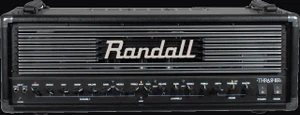
Randall built the Thrasher 50 as a 2-channel, 4-mode tube amplifier head rated at 50 watts, positioning it as a compact but robust unit within the Thrasher line. The circuit runs on a complement of four 12AX7 and two 6L6 tubes, with a global tube boost stage sitting across both channels.

Channel 1 provides separate high-frequency and low-frequency gain controls alongside a full three-band EQ — Bass, Middle, and Treble. Channel 2 offers independent Volume, Gain, and Tone controls. Both channels share global Presence and Depth controls for power-amp voicing, and a Master Volume. The effects loop is a class A discrete instrument-level design with two sends and two returns. Speaker outputs cover 4, 8, and 16-ohm loads across five output jacks, and the rear panel also carries MIDI In, MIDI Thru, and a Line Out. The included RF2-LED footswitch handles channel switching and boost mode. The chassis features heavy-duty metal front and rear grilles and corners throughout.

Owners sourcing replacement 12AX7 or 6L6 tubes, footswitch cables, or speaker cables should confirm pin configurations and impedance matching against these specifications; a qualified amplifier technician can assist with biasing after any output-tube substitution.

Q&A
Have Questions?
The owner archive

From the people who own them

Nothing in The Vault is for sale. These records exist so the instruments stay documented after the manufacturer moves on — and the most useful part of that record is what owners add to it.

Owner photos

Owner photos

Put yours on the record.

The catalog shot showed one finish, under one light, a long time ago. Yours has been played. Photos from owners are what the next person finds when they are trying to identify a part, match a finish, or work out whether the one they just bought is really what the seller said it was.

Comments

What do you know about this one?

Specs only go so far. What actually fits, what breaks first, what the factory got right and what everyone ends up changing — that lives with the people who own them, not in a datasheet. Post what you know and it stays on this page for whoever comes looking next.

RELATED PRODUCTS

Gear Help, Handled

From spec questions to full builds — players who have lived this gear since 2007.

Since 2007

Fit & Compatibility

  • Bridge, tuner, and nut fit confirmed for your guitar
  • Pickup and electronics compatibility checks
  • Pedal power and amp/cab impedance matching
Ask Before You Buy

Mods & Upgrades

  • Upgrade paths for the guitars you already own
  • Wiring, routing, and hardware swap guidance
  • Advice from people who actually do the mods
Talk Mods

The Vault

  • Discontinued and EOL guitars kept on record
  • Specs, history, and known part compatibility
  • Share your builds and mods with the community
Enter The Vault